
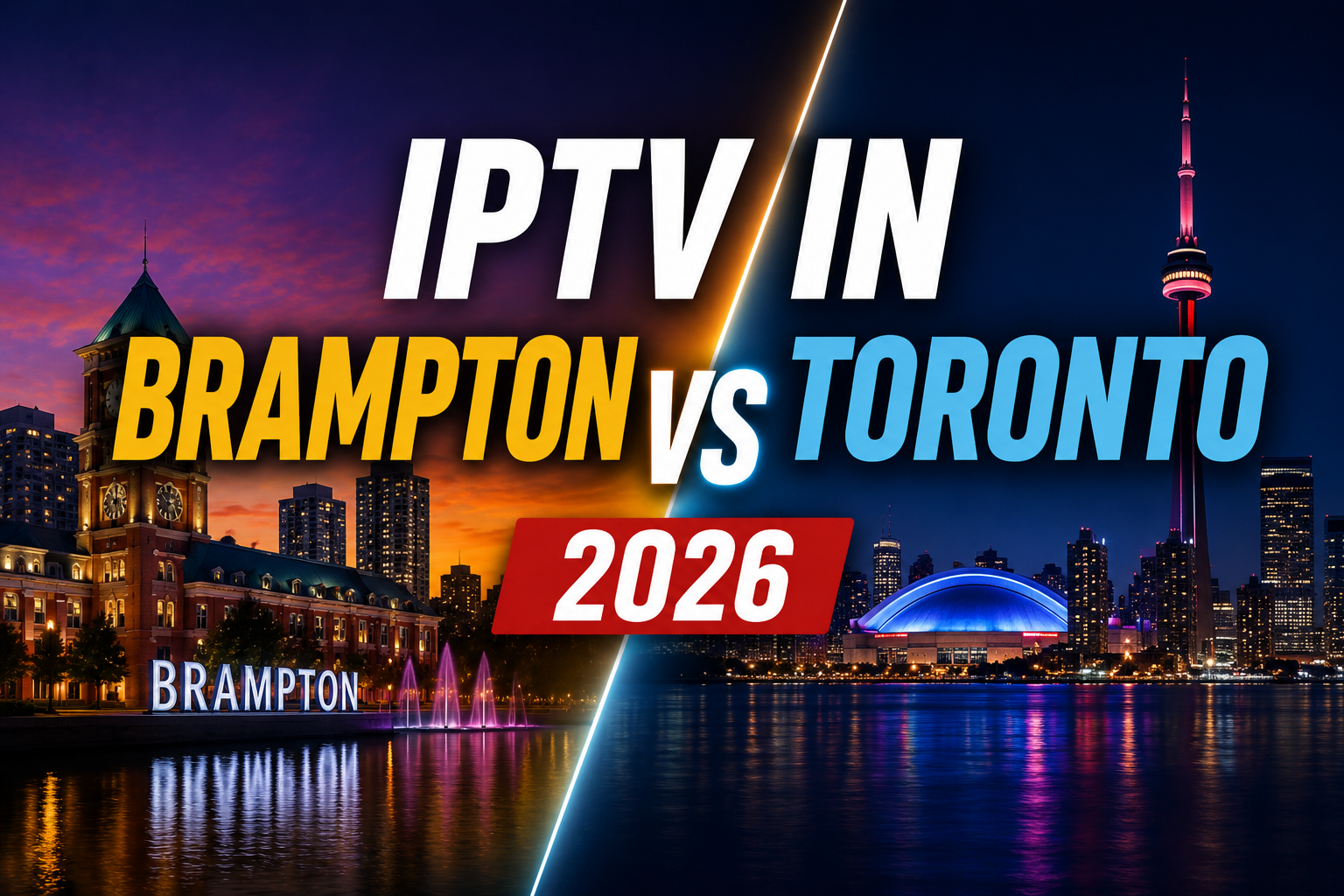
Updated: July 2026 · Reading time: 13 min · GTA comparison guide
Quick answer: Brampton and Toronto both work well for IPTV in 2026, but the setup that fits each city is slightly different. Toronto has denser fibre infrastructure and Beanfield coverage in many condo buildings, giving downtown residents the smoothest IPTV experience possible. Brampton has more concentrated community demand and larger multi-generational households, making channel breadth and multi-room streaming the priority. Both cities pay the same $19–$25/month for a Canadian iptv service, share the same Sportsnet feeds for Leafs and Raptors games, and have the same list of reliable providers. The right choice depends on your building, your ISP, and your household — not your postal code.
Brampton and Toronto sit 40 kilometres apart on the map but have very different IPTV realities on the ground. Both are Rogers and Bell territory. Both share the same Sportsnet Ontario broadcasts for Leafs, Raptors, and Blue Jays games. Both have massive demand for multicultural channels. But Toronto’s denser infrastructure, condo-heavy housing, and neighbourhood-by-neighbourhood community mix means the ideal IPTV setup looks different than in Brampton’s more suburban, multi-generational household context. This guide compares IPTV in the two cities across ISP performance, channel priorities, cost, device recommendations, and everyday problems — so you can build the setup that actually fits where you live. Whether you’re in Scarborough or Springdale, downtown Toronto or downtown Brampton, Etobicoke or Bramalea, this covers what you actually need to know.
Brampton vs Toronto at a Glance
Here’s the fast comparison for anyone who wants the summary before diving deeper.
Same technology, same starting price, different practical setup depending on the city. The rest of this guide unpacks each of those differences.
ISP Landscape: The Real Technical Difference
The single biggest difference between IPTV in Brampton vs Toronto is what’s under the ground and inside the walls. Fibre density, ISP competition, and infrastructure age vary meaningfully between the two cities.
- Rogers Ignite dominates most of the city
- Bell Fibe growing especially in newer developments
- Beanfield in a handful of downtown condo buildings only
- Peak-hour throttling in dense residential neighbourhoods
- Typical speeds 500 Mbps to 1.5 Gbps
- Rogers and Bell both extensive citywide
- Beanfield covers huge chunks of downtown and midtown condos
- Cogeco in select pockets
- Fibre penetration higher, especially south of Eglinton
- Speeds up to 3 Gbps symmetrical on Bell Fibe
What This Actually Means for IPTV
The practical implications:
- Brampton IPTV users are more likely to hit Rogers evening throttling, especially in Bramalea and Heart Lake dense residential zones
- Toronto IPTV users in condos with Beanfield have the smoothest possible experience — no throttling, no QoS interference, symmetrical speeds
- Toronto IPTV users in older Rogers cable buildings can have a worse experience than a well-configured Brampton Fibe user in Springdale
- Both cities benefit from the same fixes: Ethernet, Cloudflare DNS at the router level, Bell Home Hub in bridge mode when applicable
Verdict: Toronto has a slight infrastructure edge on average, but Brampton catches up in newer developments. Where you live within each city matters more than which city you’re in. For the deeper cable-vs-streaming picture, see our full comparison of IPTV vs cable in Canada.
Neighbourhood-by-Neighbourhood: What Each Area Actually Gets
Coverage varies significantly by neighbourhood in both cities. Here’s how IPTV typically performs in the areas people actually search for.
Brampton neighbourhoods
Toronto neighbourhoods
The pattern is clear: Toronto has more micro-communities per neighbourhood, which shifts what channels matter most block by block. Brampton has larger concentrated communities, which shifts what channels matter most household by household.
Community Demand: How Channel Priorities Differ
Both cities are multicultural, but the shape of that diversity is different.
- South Asian channels dominate demand (~40%)
- Punjabi especially — largest community in Canada
- Portuguese, Filipino, Caribbean significant secondary
- Households often need one language pack deeply
- Concentrated rather than spread across many
- Distributed across many communities
- Scarborough: Tamil, Chinese, Filipino
- North York: Persian, Chinese, Korean
- West End: Portuguese, Italian, Spanish
- Households often need multiple language streams
Where the Demand Overlaps
Both cities share the same core demand for:
- Toronto teams sports (Leafs, Raptors, Blue Jays, TFC)
- Premier League and Champions League
- English Canadian channels (CBC, CTV, Global, Citytv)
- News (CBC News Network, CP24)
Where They Differ
- Brampton: heavier concentrated demand for Punjabi channels and IPL cricket
- Toronto: more distributed multi-language demand across Tamil, Chinese, Persian, Portuguese, Greek, and others
- Brampton: cricket viewing concentrated in South Asian community
- Toronto: cricket viewing distributed across South Asian and Caribbean communities
Verdict: A Brampton IPTV subscriber typically needs deep coverage in one or two communities. A Toronto IPTV subscriber often benefits from breadth across many. Either way, the same providers can deliver both — the trick is checking channel lists before you subscribe. See our guide to the best IPTV player for Canada to see how the top apps handle multi-language navigation.
Sports: Same Teams, Same Channels, Same Priorities
Both Brampton and Toronto watch the same Toronto teams. The sports picture is nearly identical between the two cities:
- Toronto Maple Leafs — Sportsnet Ontario carries the majority of games
- Toronto Raptors — Sportsnet and TSN split coverage
- Toronto Blue Jays — Sportsnet exclusive Canadian rights
- Toronto FC — TSN and MLS Season Pass
- Toronto Argonauts — TSN
Where they differ:
- Brampton households often watch cricket, kabaddi, and IPL alongside Toronto teams — a full sports slate spans multiple continents
- Toronto households tend toward a wider European soccer mix (Premier League, Champions League, Serie A, Primeira Liga) reflecting the borough-by-borough diaspora communities
- Both cities have universal Leafs and Raptors demand — that’s non-negotiable for any IPTV service serving the GTA
For a full walkthrough on Leafs coverage without cable, see our guide on watching the Toronto Maple Leafs without cable.
Cost Comparison: Same Bills, Different Add-Ons
The cable math is different between the two cities — but the IPTV math is identical.
Brampton household typical bill
Toronto household typical bill
IPTV in both cities: identical pricing
Whether you’re in Toronto or Brampton, you’re saving $150+ per month by switching to IPTV. The math works the same in both cities. See our full IPTV cost breakdown for what the upfront device costs look like.
Device Recommendations for Each City
Both cities use the same IPTV apps and support the same devices, but housing type shifts what tends to work best.
- Firestick 4K Max or Android TV box works everywhere
- Multi-room setup common (2–3 TVs + phones)
- Ethernet-friendly houses simplify setup
- Grandparent Firestick + Smarters Pro is a staple
- Apple TV 4K popular in downtown condos
- NVIDIA Shield for Beanfield or Bell Fibe users
- Firestick still king for budget setups
- WiFi-only more common where Ethernet is impossible
Devices that work equally well in both cities include Firesticks, Android TV boxes, smart TV apps, iOS and Android phones, and any laptop. No city-specific compatibility issues exist. For step-by-step device setup, see our Firestick IPTV installation guide.
Peak Hours and ISP Behaviour: When Each City Slows Down
Both cities experience peak-hour throttling. The pattern differs enough to matter for your setup.
📊 Brampton peak patterns
- Sharp evening peak 7–11 PM — classic dinner-then-TV pattern in family households
- Secondary peak 6–10 AM during IPL season — cricket viewing concentrated in one time window
- Weekend afternoons quieter — fewer people streaming during outdoor family time
📊 Toronto peak patterns
- Extended peak 6 PM–midnight — larger population, more shift workers, longer sustained load
- Continuous background congestion — always someone streaming something
- Weekend afternoons stay busy — dense population keeps traffic high
- Downtown condo buildings can hit building-level congestion at any hour
Practically, this means:
- Brampton users should prioritise buffer size, DNS change at the router, and Ethernet for evening viewing
- Toronto downtown users should prioritise ISP quality (Beanfield if available, Bell Fibe otherwise) and a modern router
- Both cities benefit from the same set of fixes
For provider recommendations that handle GTA peak hours well, see our list of the best IPTV providers in Canada.
Which City Is Better for IPTV? The Honest Answer
Neither. Both are excellent.
- Toronto has a slight infrastructure edge — more fibre, more Beanfield, more competitive ISP market
- Brampton has a slight demand-fit edge — concentrated communities means providers optimise heavily for those channels
- Setup differs slightly — Brampton is more Ethernet-friendly, Toronto is more WiFi-dependent
- Cost is identical — $19–$25/mo in both cities
- Channel availability is identical — same Canadian IPTV services serve both cities equally
The real answer: pick the setup that fits your specific building, ISP, and household — not your city. A downtown Toronto Beanfield condo user and a Springdale Bell Fibe house user will have similar great experiences. A Bramalea Rogers coaxial apartment user and a Scarborough Rogers coaxial apartment user will face similar peak-hour challenges. The building matters more than the city.
Moving Between Cities: Does Your IPTV Setup Transfer?
Yes. Completely.
- IPTV subscriptions work anywhere in Canada — no city-specific licences or geo-restrictions
- Move your Firestick or Android box to your new place, log back in, done
- Your subscription, channels, EPG, and favourites all follow you
- What changes: your ISP might be different, so peak-hour behaviour may shift
- What stays the same: everything else
If you had TiviMate recording schedules or custom favourites set up, back up your configuration before moving so you can restore it in seconds at the new place. This makes IPTV especially convenient for renters, students bouncing between Brampton and downtown Toronto, and anyone with property in both cities. If you’re new to IPTV in general, our what is IPTV explainer covers the basics of how the technology works and why it’s portable.
Beyond Brampton and Toronto: Adjacent GTA Cities
The same setup principles apply across the broader GTA. If you landed here from an adjacent city:
- Mississauga — mirrors Toronto pattern (Bell + Rogers + Beanfield in some buildings)
- Scarborough — technically Toronto but often searched separately; huge Tamil and Chinese communities
- Markham and Richmond Hill — similar to North York in dense Chinese community demand
- Vaughan — mixed Italian, Persian, Russian communities; Bell Fibe strong
- Etobicoke — mixed infrastructure, varied performance
- Oakville, Burlington, Halton region — mirrors Brampton’s suburban setup pattern
All of these cities benefit from the same IPTV setup principles: good internet, decent device, reliable provider, verified channel list.
Is IPTV Legal Across the GTA?
Yes. IPTV as a technology is fully legal across Ontario and Canada. Legality of specific providers depends on their licensing arrangements with content owners, not on where you live in the province. There are no city-specific IPTV restrictions in Brampton, Toronto, or anywhere else in the GTA. For the full picture, see our guide on IPTV legality in Canada.
Frequently Asked Questions
Is IPTV better in Toronto or Brampton?
Neither is objectively better. Toronto has a slight infrastructure edge in condo buildings with Beanfield or Bell Fibre. Brampton has strong performance in newer developments with Bell Fibe. Your specific building and ISP matter more than your city.
Do the same IPTV services work in both cities?
Yes. Canadian IPTV subscriptions have no geographic restrictions within Canada. The same providers serve Brampton, Toronto, Mississauga, Scarborough, and everywhere else in the GTA equally.
Is peak-hour throttling worse in Toronto or Brampton?
Both cities experience throttling. Toronto’s peak lasts longer (dinner through late night); Brampton’s is sharper between 7 and 11 PM. Brampton also sees additional early-morning peaks during IPL cricket season.
Do Brampton and Toronto watch different channels?
Sports demand is identical — same Leafs, Raptors, and Blue Jays feeds. Multicultural channel demand differs: Brampton concentrates on South Asian channels, Toronto spreads across more communities including Tamil, Chinese, Persian, Portuguese, and others.
Can I use my IPTV subscription if I move between Brampton and Toronto?
Yes. Log in on any device in your new location — subscription, favourites, and channel access transfer immediately.
Is Bell Fibe better than Rogers Ignite in the GTA for IPTV?
Bell Fibe with Home Hub in bridge mode tends to perform slightly better in both cities, especially during peak hours. Both work reliably with the right configuration.
Does Beanfield make Toronto IPTV better?
Yes. Beanfield fibre is available in select Toronto condo buildings and delivers the cleanest IPTV experience possible — no throttling, no QoS interference, symmetrical speeds up to 3 Gbps.
Which is cheaper — IPTV in Brampton or Toronto?
Identical pricing in both cities. $19–$25 CAD per month depending on plan length. The same providers serve both markets at the same rates.
Do I need different setup for downtown Toronto vs suburban Brampton?
Yes, slightly. Toronto downtown condos benefit from Wi-Fi 6 or Ethernet-to-router setups. Brampton suburban houses benefit from wired Ethernet direct to the streaming device. Both cities use the same apps and channels.
Can I get Punjabi channels in Toronto and Portuguese channels in Brampton?
Yes. IPTV lineups are the same across the GTA. Every language is available in every city — you just need to confirm your specific provider carries the channels your household wants.
Final Take
Both cities are excellent for IPTV in 2026. The right setup is defined by your building, your ISP, and your household — not your postal code. Brampton and Toronto share the same Sportsnet feeds, the same Toronto teams, the same Canadian IPTV services, and the same $19–$25 monthly pricing. Where they differ is in infrastructure density (Toronto edge), community demand concentration (Brampton edge), and peak-hour patterns (both cities have them, expressed differently).
Whether you’re in Scarborough or Springdale, downtown Toronto or downtown Brampton, Etobicoke or Bramalea, the same principles apply — decent internet, a reliable streaming device, and a Canadian iptv provider that carries the channels your household actually watches. Start by confirming the specific channels that matter to your family — Sportsnet for the Leafs, PTC for grandma, Sun TV for the Scarborough cousins, whatever combination makes your home run — and test them during the free trial period before signing up for anything long-term.